
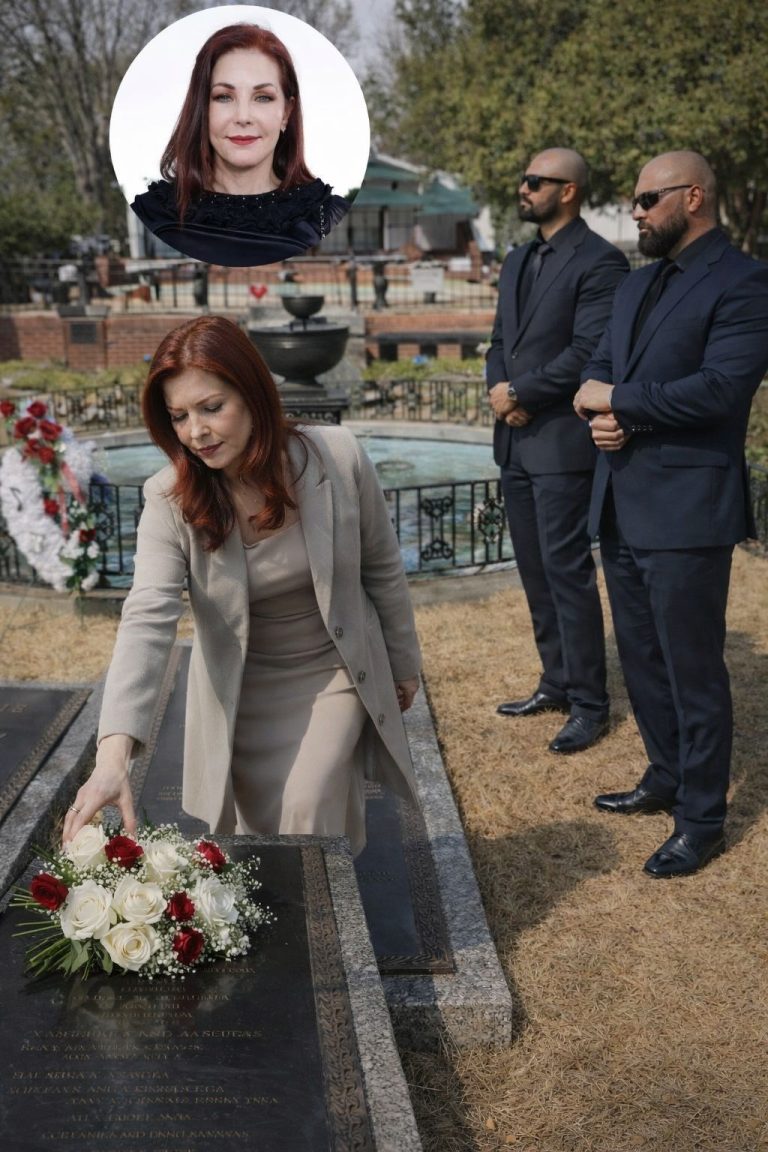
Graceland stood still under a heavy sky just hours ago, its quiet grounds once again becoming the center of an emotional storm that few had anticipated. Priscilla Presley, a woman long tied to the legacy of Elvis Presley, was at the heart of a revelation that has left fans unsettled and deeply reflective. Reports indicate that her final wish—to be laid to rest beside Elvis—was respectfully but firmly denied, a decision that has sent ripples far beyond the gates of the historic estate. Such a moment, rooted in remembrance and closure, has instead reopened questions that many believed had been laid to rest decades ago.
Inside those iconic walls, where memories of music, fame, and personal sacrifice linger, an invisible boundary appears to have drawn a line between past devotion and present authority. This was not merely a personal request declined—it felt like a symbolic turning point, one that subtly redefines who holds the power over one of the most cherished legacies in American cultural history. Observers close to the situation suggest that the refusal carries weight far beyond logistics or tradition, hinting at unresolved tensions that have quietly endured through generations.
Emotional responses have poured in from admirers around the world, many struggling to reconcile the image of unity long associated with Elvis's memory and the emerging signs of division within the family. Graceland has always been more than a residence—it represents a sacred space where history and identity intertwine, and any decision concerning it inevitably carries profound meaning. That meaning now feels fractured. Silence from key figures has only intensified speculation, allowing whispers to grow louder in the absence of clarity.
Sources familiar with the inner circle describe an atmosphere thick with unspoken understanding, where decisions are made carefully yet leave lasting emotional echoes. One quiet statement reportedly shared behind closed doors captured the gravity of the moment: there are truths that remain unspoken, not because they lack importance, but because revealing them could alter everything people believe about the past. That sentiment alone has fueled a growing sense that something deeper lies beneath the surface.
Beyond the immediate emotional impact, this development raises broader questions about legacy stewardship. Who truly defines the final chapter of a legend's story? Is it shaped by love, by lineage, or by decisions made long after the spotlight has faded? Graceland, once viewed as a place of unity and remembrance, now appears to stand at the center of a quiet but undeniable shift. Each choice made within its grounds echoes outward, influencing how future generations will understand the story of Elvis Presley and those closest to him.
Careful observers note that moments like this rarely exist in isolation. They often reveal patterns—subtle fractures that have been present for years but only become visible under pressure. The refusal of such a deeply personal wish suggests that the balance between honoring memory and asserting control may be more fragile than anyone realized. That fragility now invites scrutiny, not only from devoted fans but also from those who study the enduring impact of cultural icons.
Graceland remains standing, unchanged in structure yet transformed in meaning. Visitors may still walk its halls and feel the presence of history, but something intangible has shifted. A question lingers in the air, difficult to ignore and impossible to fully answer: what truths remain hidden behind decisions like this, and how many of them have yet to surface?
Silence continues, yet it no longer feels peaceful—it feels deliberate. Each unanswered question adds weight to a narrative that refuses to settle. Legacy, once thought unshakable, now appears vulnerable, not because of what has been revealed, but because of what remains concealed.
Outrage quietly builds among those who believed the story of Elvis Presley had already been written with clarity and respect. Instead, a new chapter has begun—one marked by restraint, division, and unresolved emotion. The foundation of a cultural legacy now seems less certain than ever, and as speculation deepens, one truth becomes impossible to ignore: this mystery has not reached its conclusion, and whatever lies beneath may yet reshape everything the world thought it understood.