
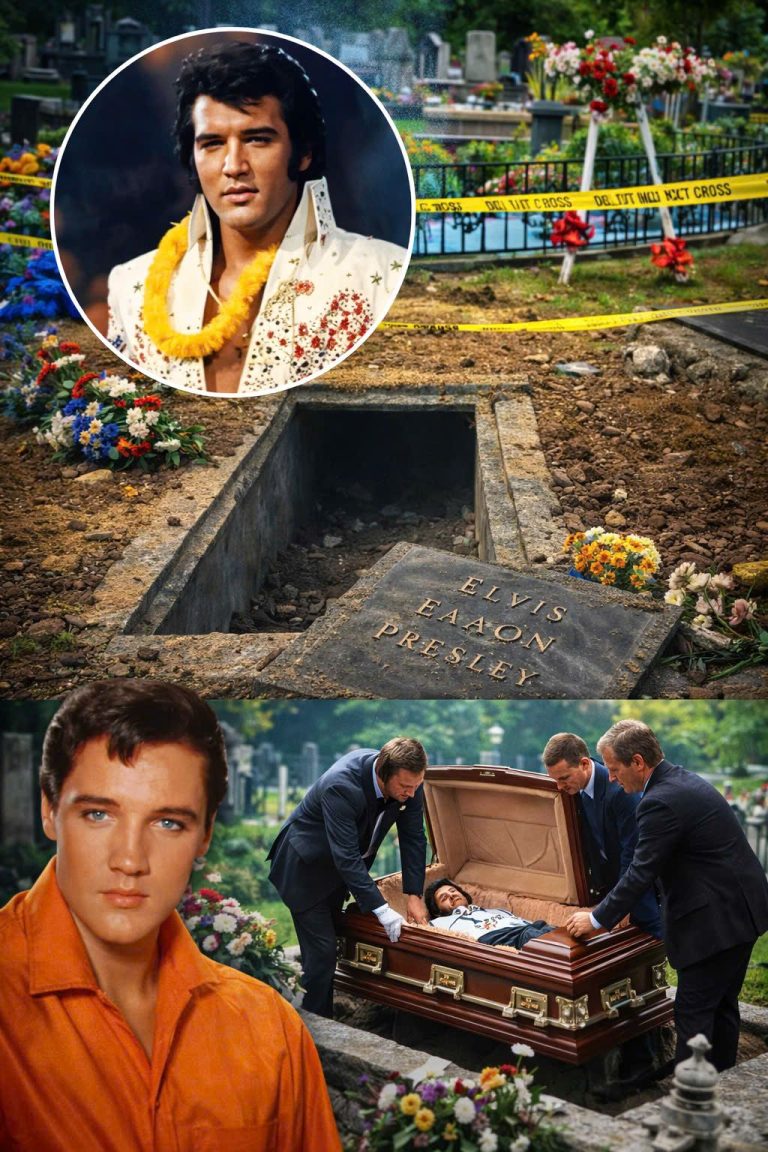
In the quiet heart of Memphis, where time seems to stand still around the legacy of Elvis Presley, an unexpected development has stirred emotions that many believed had long settled into history. For decades, his final resting place remained untouched—a symbol of closure, reverence, and enduring mystery. But recent reports suggest that officials made a decision few could have imagined: to reopen what was meant to remain sealed forever. The moment this action took place, it was as if the past itself had been gently, yet undeniably, awakened.
Those present described an atmosphere filled with deep tension and quiet anticipation. This was not merely a procedural act—it carried the weight of history, memory, and a global legacy that has never truly faded. Elvis was not just a performer; he was a cultural force, a voice that defined generations. And so, any disturbance to his final chapter naturally invites both curiosity and unease. What could possibly justify such a step after so many years?
As details began to surface, they did not bring clarity—only more questions, more uncertainty, and a growing sense that something was not as expected. Individuals close to the situation spoke carefully, choosing their words with caution, yet their tone revealed an unmistakable concern. It was not shock alone, but something deeper—a quiet realization that the story may not be as complete as once believed.
💬 "What we found… it doesn't fully align with what history has told us."
That single statement has echoed far beyond Memphis, reaching fans and observers around the world. For many, Elvis represents more than music—he represents a moment in time that felt larger than life itself. To suggest that there may still be unanswered questions is to reopen not just a physical space, but an emotional one as well. It challenges the sense of certainty that people have held onto for years.
What makes this situation even more compelling is the silence that has followed. Officials have not rushed to explain. There has been no definitive statement, no clear resolution—only a careful, almost deliberate withholding of information. And in that silence, speculation naturally grows. Some believe it is simply a matter of routine verification or preservation. Others wonder if there is a deeper reason—one tied to details that were never fully revealed to the public.
It is important to approach such moments with respect and thoughtfulness. Elvis Presley's legacy is not defined by mystery alone, but by his music, his influence, and the emotional connection he created with millions. Yet history has shown us that even the most well-known stories can hold unexpected layers. Sometimes, what we think we understand is only part of a much larger picture.
As conversations continue, one thing is certain: this moment has reignited interest in a story that never truly faded. It reminds us that legacies are not static—they evolve, they are revisited, and occasionally, they are questioned. Whether this development will lead to new understanding or simply deepen the mystery remains to be seen.
And so, we are left with a quiet but powerful question—was this reopening an attempt to confirm the past, or has it uncovered something that was never meant to be fully known?